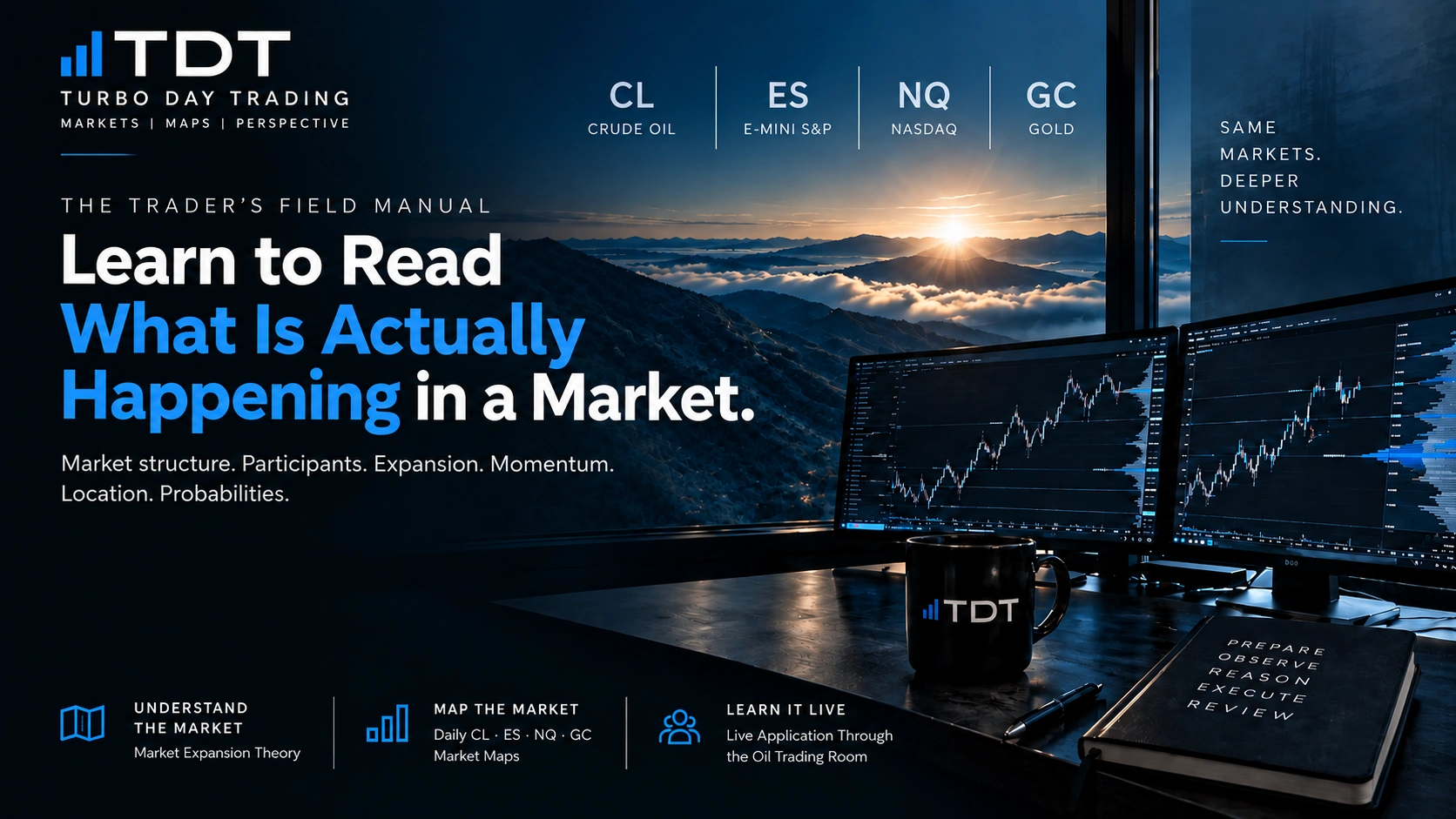
A Different Way to Read a Market
From Signals to Market Understanding
Turbo Day Trading is a pro futures day trading room devoted to the art of understanding how markets work from the ground up.
Why?
Most traders eventually accumulate enough indicators, setups, and signals. The harder problem is understanding what those signals mean in the market that exists right now.
A signal does not exist in isolation. Its meaning changes with location, structure, participation, momentum, range behavior, and whether the market is rotating or expanding.
Turbo Day Trading brings those pieces together into a framework for reading the market as it unfolds — so the question becomes less “Did I get a signal?” and more “What does this add to what I already know?”
Markets leave evidence as they rotate, expand, reject, accept and change direction.
Learn to recognize who appears to be present, who may be in trouble—and where meaningful opposition may be absent.
A useful interpretation changes when the evidence changes.
Reading the Market in Context
No single indicator, level, pattern or piece of information tells the whole story.
What matters is how location, structure, participation, momentum and range behavior relate to one another as conditions change.
The objective is not to predict every move. It is to recognize what matters, what doesn’t, what the market is trying to do, what stands in its way, and how much opportunity remains.
What You Get as a Member
Learn to Read a Live Market
Learn where and how markets move—and how to follow the market as an unfolding narrative. Separate what matters now from what doesn’t, recognize changing conditions, and understand what the market is actually trying to accomplish.
Market Expansion Theory & Open Zones
Learn MET as a practical framework for understanding range expansion, counterparties and opportunity. Develop the ability to recognize true open zones—areas where meaningful opposition is absent or failing and price has room to move efficiently.
Daily Market Maps
Start each session with context. Market Maps for CL, ES, NQ and GC identify important structure, expected range, expansion objectives and areas where participation or opposition may matter. Additional mapping technology is continually being developed.
Trade Triggering & Execution
Turn market understanding into action. Learn how we combine location, structure, momentum and efficient order flow to identify actionable trade opportunities. New chart-based triggering technology is currently being developed for members, beginning with efficient-order-flow triggers and expanding toward counterparty and open-zone recognition.
The Trader’s Field Manual, MET Lecture Series + Daily Lectures
The Field Manual establishes the framework. The recorded MET Lecture Series explores those principles through actual trading-room discussions, showing how market behavior reveals structure, participation, probability and expansion. Daily live lectures build on both, applying these concepts to unfolding markets and developing recognition, execution skills and trading fluency through repeated experience.
Trading Systems, Research & Professional Perspective
Go beyond using somebody else’s signals. Learn how trading systems and indicators are designed as measurement technology: what to measure, why it matters, how ideas are tested, and how market knowledge becomes trading logic. Participate in a room built around decades of proprietary research, a Robbins World Cup futures champion, and experienced traders who bring their own observations and perspectives.
Take Your Trading to the Next Level
Turbo Day Trading is designed for traders who want to move beyond simply finding another setup, indicator or trading system.
It is also for traders who recognize that AI and programming can build what you tell them to build—but they cannot replace the market expertise required to know what should be built in the first place.
Before you can design, automate or improve a trading system, you need to understand the market it is intended to trade: what drives it, when and where those forces matter, what normal behavior looks like, and when the environment has changed.
Learn to recognize what the market is trying to do—and the most likely direction for range expansion.
Bring your own trading system and learn to understand the environment in which it operates. Use that understanding to improve its logic, filters and application.
Or learn the methods and trading tools we use. The Trader’s Field Manual and Market Maps are included with membership.