TTOA — Reading Order Flow and Market Participation
The Trader's Field Manual explores order flow as evidence of market participation, rather than simply a measure of buying and selling pressure.
One of the most important distinctions is between the magnitude of order flow and its efficiency. Large amounts of buying or selling do not necessarily produce large price movements. Conversely, relatively modest participation can produce substantial price expansion when little opposition is present.
The Trapped Trader Oscillator Advanced (TTOA) helps reveal these relationships by exposing where order flow is efficient, where opposing participants may be creating resistance, and where market conditions are changing.
The annotated chart below illustrates these relationships and a central principle of the book: What matters is not simply how much buying or selling occurs, but what happens to price as a result.
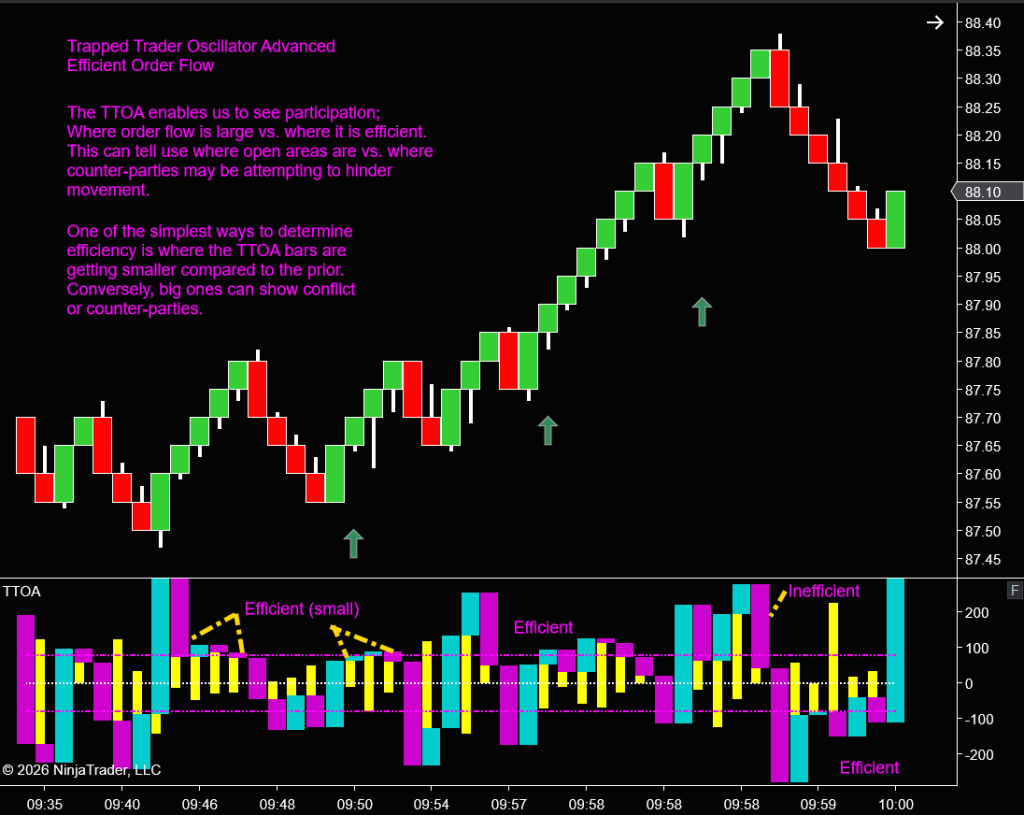
As you examine the chart, notice how price can sometimes move against apparently strong buying or selling pressure. Consider what this reveals about the participants on each side of the market, who may be encountering resistance, and who is actually accomplishing something. The relationship between order flow and price movement often reveals more than either one alone.
As you examine the chart, compare the size of the TTOA bars with the distance price travels.
Notice where relatively small order flow readings accompany substantial price expansion. This suggests price is encountering relatively little opposition. Now look for larger order flow readings that produce little movement—or where price actually moves against the apparent buying or selling pressure.
Ask yourself: If so much buying or selling is occurring, why isn't price responding? Someone on the other side may be absorbing that activity.
The important observation is not simply who is buying or selling, but which participants are accomplishing something and which may be getting into trouble.
Return to The Trader's Field Manual — Chart & Research Resources
